Free handbook · chapter 3 · 10 pages · PDF
GLP-1 Side Effects, Explained
Why nausea happens, how to read the side-effect numbers for your medicine, and when to get help. A free chapter from the Fewer Bites GLP-1 handbook, by Dr. Chiranjeevi Peetla.
What is inside
Ten pages, each one traceable
Why side effects happen (pages 2 to 5)
Two likely routes to nausea: a brainstem "border checkpoint" shown in animals, and a slower, fuller stomach. Which one matters most in people is not known, and the chapter says so.[13]
Ask AI to explain a page (page 9)
One prompt that keeps an AI assistant tied to the passage you paste, with a worked example and a list of what to keep out of the chat.
What to do next (page 10)
The companion episode, how to hear about the full handbook, and the author and sourcing notes.
Get the free handbook
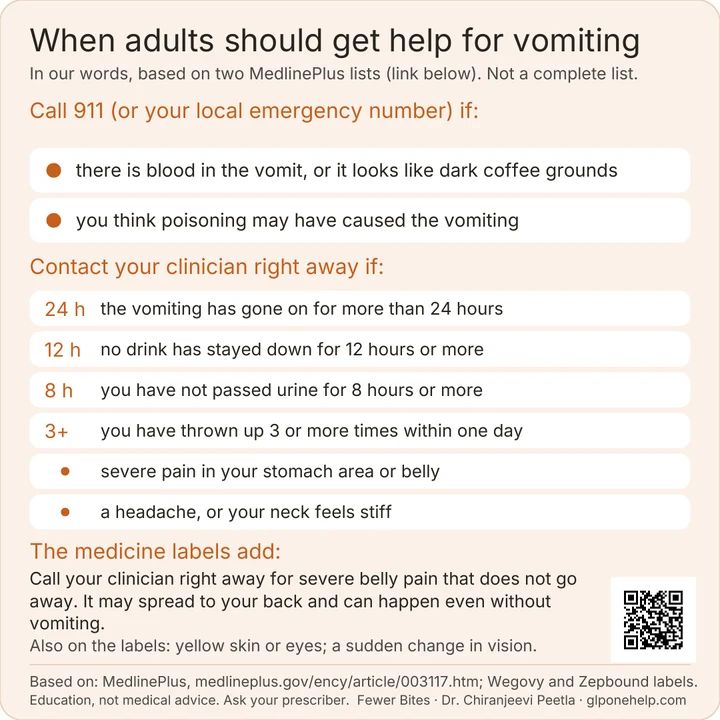
A 10-page PDF: why side effects happen, the trial numbers for Wegovy and Zepbound, and a help card for your phone. Free, no catch.
The download appears right away. We email when a new chapter or card is published, and once more for each box you tick. Leave both boxes empty and Your First 12 Weeks still comes free by email in a few weeks. No selling of your address, ever. Unsubscribe in one click. Privacy.
Pages 7 and 8
Side effects reported in the trials, people out of 100
Counts are people who reported the effect at least once during the trial. The placebo group is a dummy injection, so some of every number is not the medicine. Indigestion means dyspepsia.
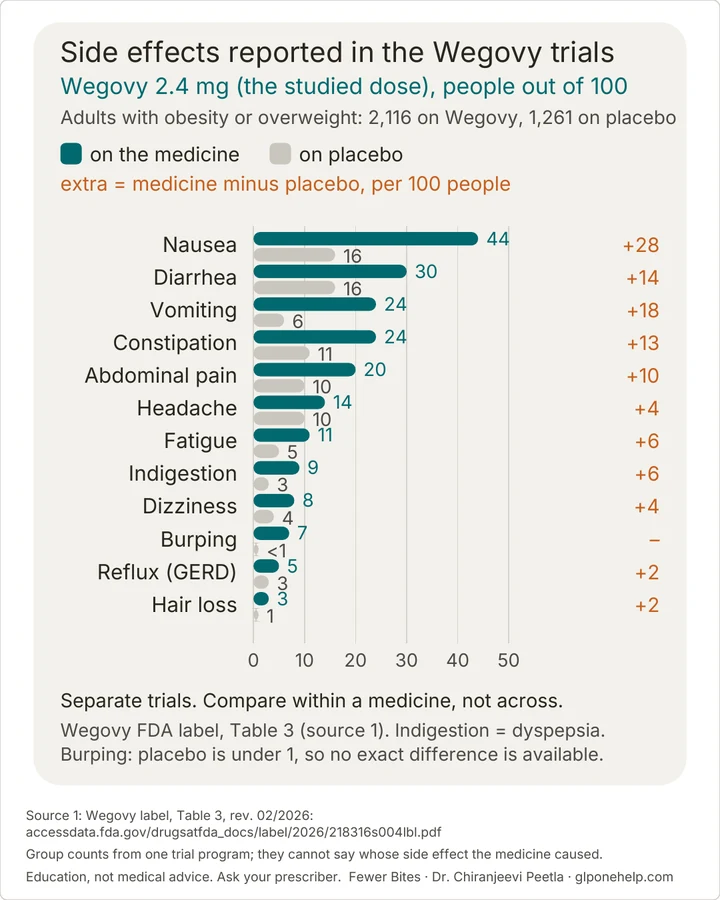
Wegovy 2.4 mg
Adults with obesity or overweight. Source: Wegovy FDA label, Table 3.[1]
Save card (PNG)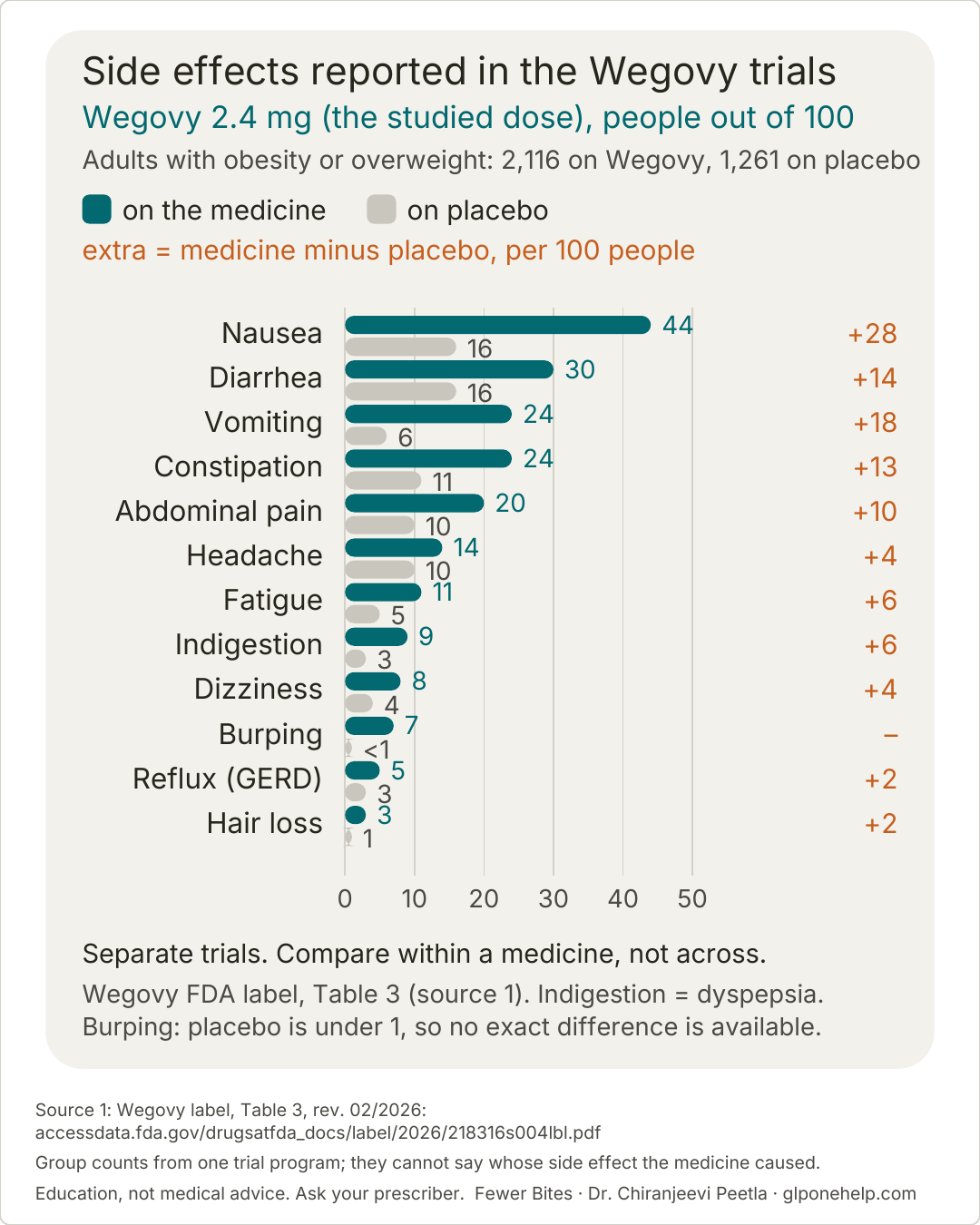
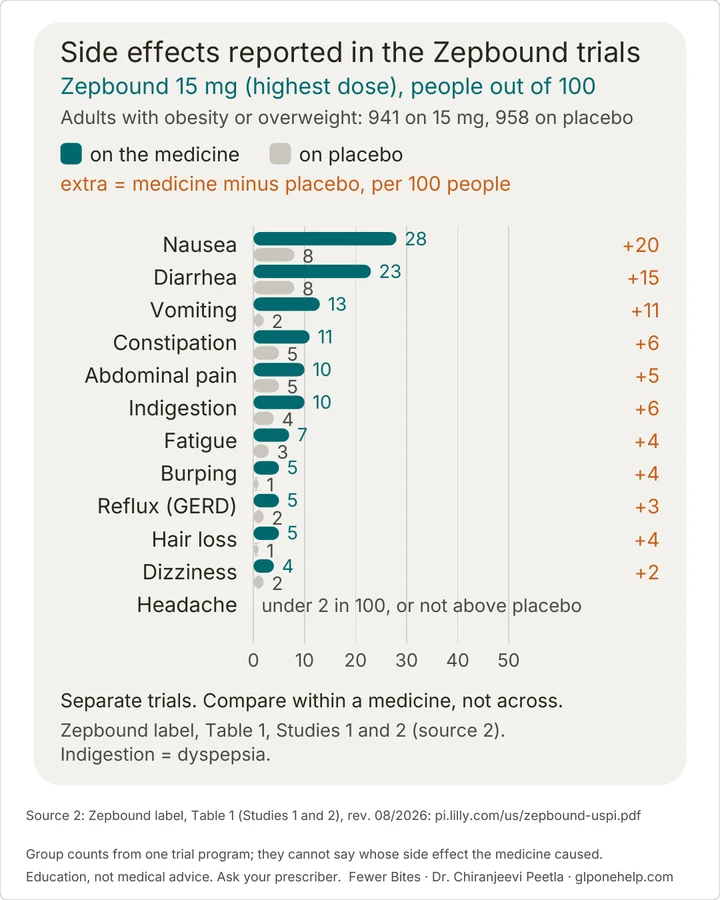
Zepbound 15 mg
Highest studied dose. Source: Zepbound label, Table 1, Studies 1 and 2.[2]
Save card (PNG)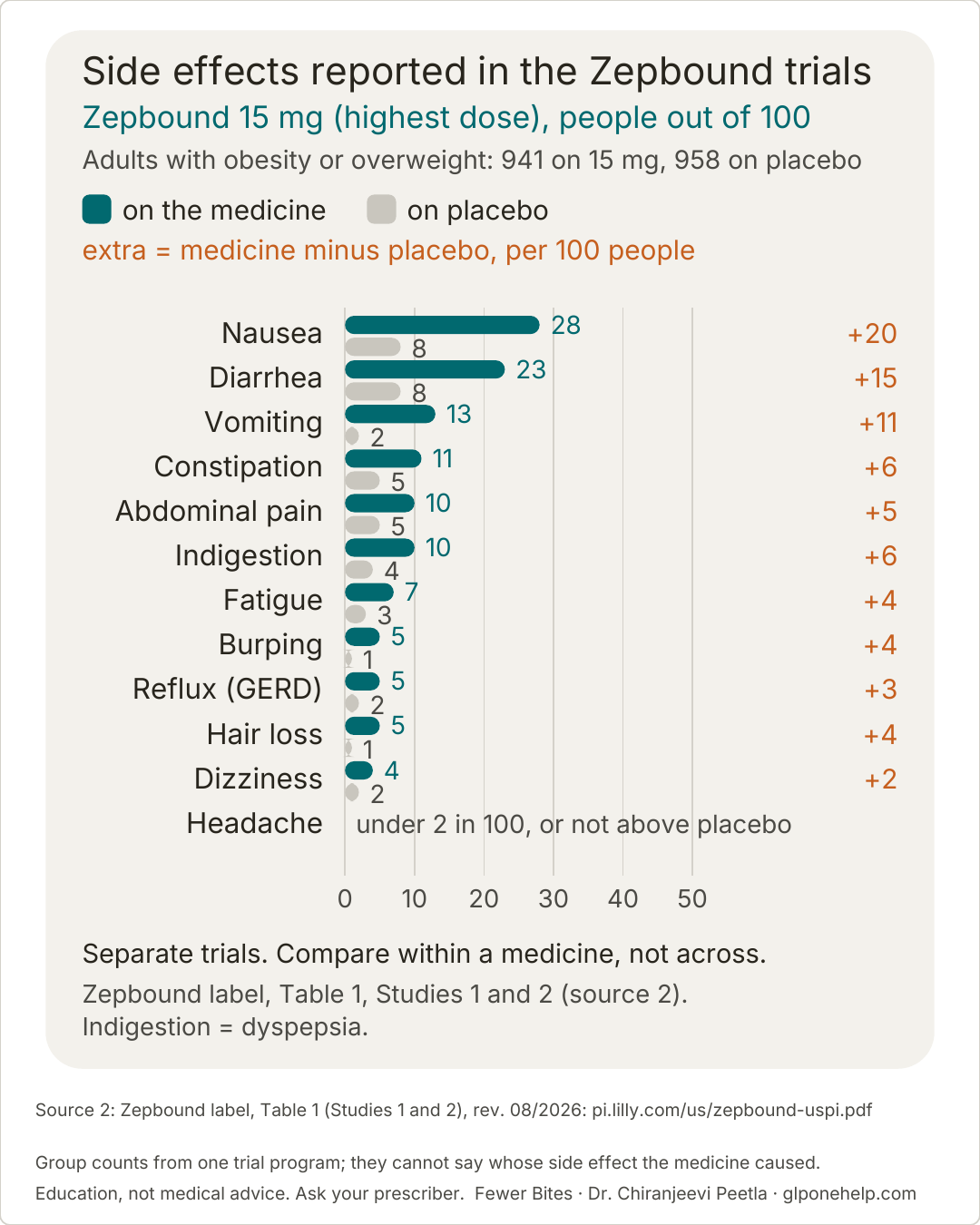
The myth the chapter takes apart
"Nausea means it's working"
In the pooled Wegovy trials, weight loss was large in people who never had nausea, and stomach side effects explained less than one percentage point of the weight lost.[13] Nausea is a side effect, not a sign of success. The chapter walks through how the researchers checked this.
What is still unknown
- Which nausea route matters most in people.
- Why nausea fades for most people.
- Why one person gets constipation and another diarrhea.
Page 9
Ask AI to explain a page
Copy this prompt into ChatGPT, Gemini, Claude or Perplexity, then paste one paragraph from the handbook. It keeps the assistant tied to the passage and your personal details out of the chat.
I'm reading the Fewer Bites handbook. Use only the passage I paste below. Explain it in three short sentences for someone with no science background. If there's a number, tell me who was studied, what was counted, and what the comparison was. Tell me one thing the passage cannot establish about an individual person. Finish with one question I could ask my prescriber. If the passage doesn't answer something, say so. Don't diagnose symptoms or suggest starting, stopping, or changing treatment.

Passage: [Paste a paragraph or chart caption from the handbook.]
Keep these out of the chat
Your name, your medical records and your own symptoms. An AI assistant is not a clinician. If the answer adds a dose, a diet tip, a reason to stop or a diagnosis, ignore it. That gap belongs to your prescriber.
Questions to take to your prescriber
This site explains; it does not decide. These are the questions the chapter leaves you with.
- Which side effects should I report right away, and which can wait for our next visit?
- What result should I expect by week 12, and what would make you change the plan?
- I take this medicine; who on my surgical or dental team needs to know before a procedure with sedation?
- Do any of my other medicines or conditions change how you will monitor me?
About the full handbook (the honest note)
The full edition will be an illustrated, question-led book: a chart with its source for every number, and the questions to take to your prescriber after each chapter. It does not exist yet, and its price and length are not set. Nothing in this free chapter is cut down to sell it; the free edition and the full one are held to the same sourcing standard.
Sources
- FDA label (primary). Wegovy (semaglutide) US prescribing information, revised 02/2026. Section 6.1, Table 3. https://www.accessdata.fda.gov/drugsatfda_docs/label/2026/218316s004lbl.pdf
- FDA label (primary). Zepbound (tirzepatide) US prescribing information, revised 08/2026. Table 1. https://pi.lilly.com/us/zepbound-uspi.pdf
- primary study. Wharton S et al. Gastrointestinal tolerability of once-weekly semaglutide 2.4 mg in adults with overweight or obesity (pooled STEP trials). Diabetes, Obesity and Metabolism, 2022. https://pmc.ncbi.nlm.nih.gov/articles/PMC9293236/
- health agency. MedlinePlus Medical Encyclopedia. Nausea and vomiting: when to contact a medical professional. https://medlineplus.gov/ency/article/003117.htm
- health agency. US FDA. Review of suicidal thoughts or actions with GLP-1 receptor agonists: conclusions, January 2026. https://www.fda.gov/media/190557/download